
A Bitter Twist: Pesticides on Citrus Fruit Skins
By Sheri Dixon
Before you zest…..be aware that pesticides commonly sprayed on our citrus fruits now come with a warning that they should not be consumed.
Citrus fruits such as oranges, lemons, limes, and tangerines, satsumas are sprayed with fungicides when picked, stored, and then transported.

How many of us add a slice of lemon or lime to our cocktails, or our fruit teas, or just daily hot water with lemon.
How many of us consider ingesting cakes or biscuits containing the zest of citrus fruits.
Several fungicides such as imazalil are showing on labels at major U.K supermarkets as being unfit for consumption. Not everyone reads labels but it’s a good thing to be mindful that imazalil is a suspected carcinogen that may negatively impact reproduction and development.
Interestingly U.K supermarkets are not legally bound to state the chemicals used on produce they sell so it is sensible to be vigilant if you wish to minimise the intake of potentially harmful chemicals for you and for your loved ones.
Citrus fruits may appear to be harmless because we tend to peel them before eating the fruit or juicing, but new data indicates that the surface ‘treatments’ may enter the fruits because the skins are porous. Washing can reduce the total load of chemicals but not totally eradicate.
Pesticides and fungicides are apparently more adept at impacting hot drinks or drinks containing alcohol. Gin and Tonic anyone?
Additionally there is the total toxic load to consider which reflects the combination of pesticides, aka the ‘cocktail effect’.
The primary goals of post-harvest handling are to slow down the processes of deterioration by controlling temperature and humidity, prevent physical damage like bruising, and extend shelf life. Of course this retains profit but that should never be at the risk to human health.
To avoid the risks it is wise to choose unwaxed organic citrus, especially grapefruit and lemons and to wash fruits before using in cooking, baking, or adding to our drinks.
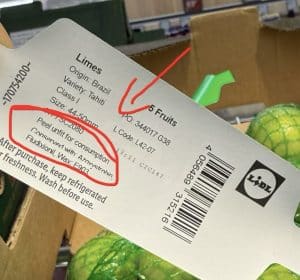
– Imazalil: A fungicide used to prevent mould, particularly green and blue mould, during storage and transport.
– Pyrimethanil: A fungicide that helps protect fruit against fungal decay after harvesting
– 2-Phenylphenol: An antimicrobial preservative used to control mould and other microorganisms on citrus skins.
– Thiabendazole: A fungicide used to protect citrus fruit against fungal spoilage during storage.
– 2,4-D: A plant growth regulator used after harvesting to help prevent the stem-end button from dropping off, which can increase the risk of decay. Interestingly, 2,4-D is also widely known as a herbicide.
– Azoxystrobin: A broad-spectrum fungicide used to control fungal diseases and fruit decay.
– Fludioxonil: A fungicide that helps protect harvested fruit from mould and rotting.
– Wax (E903 and E914): Protective coatings used to reduce moisture loss, maintain freshness and give the fruit a glossy appearance. E903 is carnauba wax, while E914 is oxidised polyethylene wax.
References:
- https://doi.org/10.1177/10820132221096995
- https://doi.org/10.1016/j.foodchem.2026.150490
Copyright © Sheri Dixon 2026 All Rights Reserved